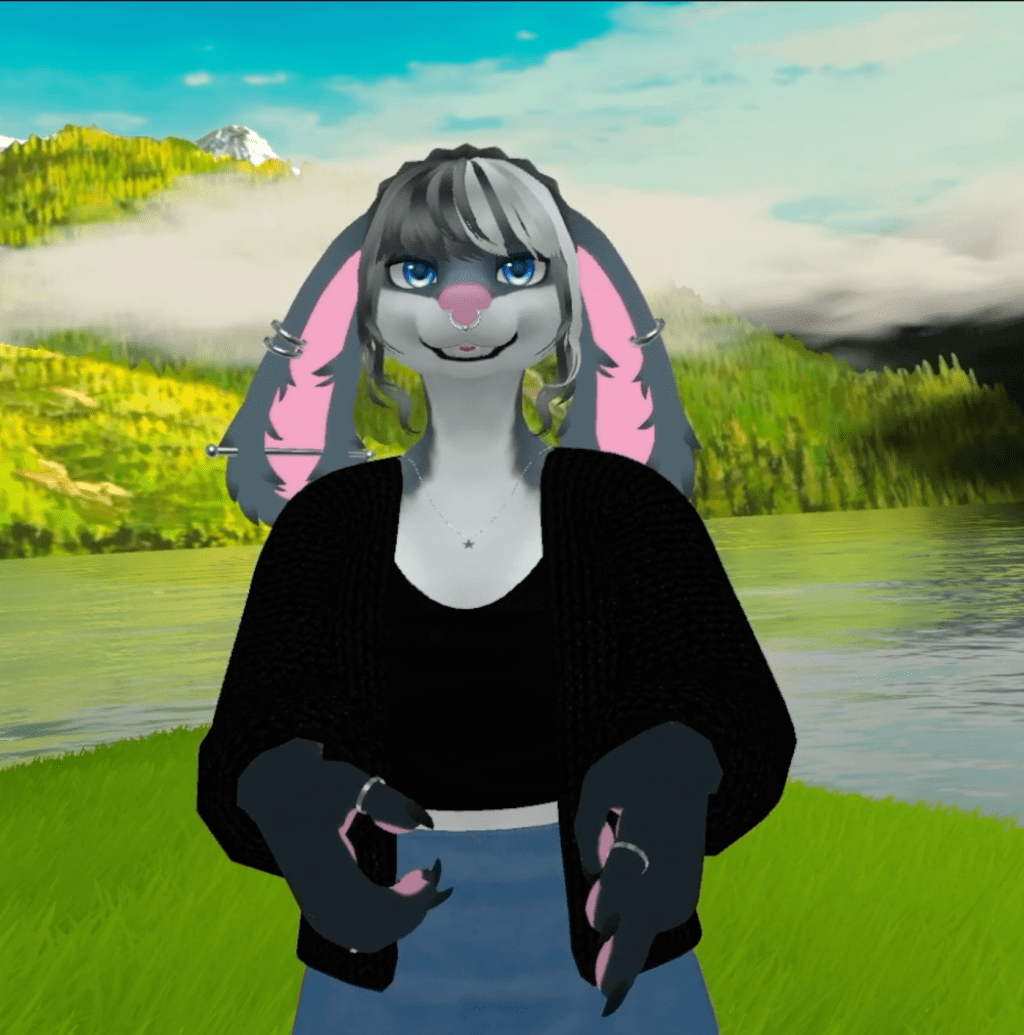
In today’s increasingly multi-modal and immersive digital playground, utopian ideals can mask the harsher realities of social virtual reality, where the effects of those seeking to provoke can feel painfully real and leave haunting questions of how humans can be so unconscious and cruel. Thawah, a budding 3D artist and community leader in social VR, shares a candid reflection on the joys and challenges of online communities.
Who is Thawah?
Identifying with she/her or they/them pronouns, Thawah is a creative force of world-building and avatar design. While she’s on the hunt for a traditional job, she approaches her creative work with professional dedication. After studying women’s and gender studies with a minor in queer studies, Thawah discovered a passion for 3D modeling, which she hopes to one day make her full-time career. A lover of music, a committed vegan for over a decade, and a fashion enthusiast, Thawah brings a rich and varied tapestry of interests to her virtual interactions. She is also a moderator of a highly diverse and talented community focused on the creative arts of social VR.
Fun that Targets and Excludes
Some might brush off trolling as online antics or “just having fun,” but Thawah points out that trolling often masks deeper issues like racism and prejudice. “If someone’s ‘joking’ with racist comments, it’s likely they actually believe those things somewhere inside,” she explains. This highlights a troubling overlap between what’s intended as humor and what is genuinely harmful when people move on from the fun they’ve had without noticing the unintended effects of how one’s actions may have actually harmed. Thawah’s insights make us question how we all participate in harmful trolling with bystanderism, laughter, or condemnation—inadvertently normalizing community cultures that target and exclude.
The Value of Chaos
When Fun Turns to Trouble
Exploring the fine line between trolling and bullying, Thawah notes that while all trolls aren’t outright bullies, their actions can still have harmful consequences. It’s about understanding that behind each avatar is a person who may be affected by what seems like a harmless provocation. “It starts as fun, but when someone gets hurt, it’s not a joke anymore—it’s bullying,” she notes. This distinction can help us recognize when to step back and reassess our involvement in what might no longer be harmless fun.
Transforming Trolls by Building Community
Confronted with trolling, Thawah concentrates on what truly matters to her: creativity, connection, and personal growth. “I’ve made it a habit to not respond to hateful comments on social media,” she mentions, emphasizing her strategy for maintaining mental peace and community integrity. Thawah sees the community as a vital support network that helps individuals find belonging, particularly when trolling and bullying seem to stem from a place of insecurity or isolation.
Tackling Misconceptions and Harassment
Thawah challenges common misconceptions around online harassment, explaining how the term “bully” is sometimes not taken seriously. “I’ve seen people try to say ‘I’m being bullied online,’ but if they use a different word, like harass, you wouldn’t argue that it’s a problem. Bullying is almost the same thing as harassing.” This insight sheds light on the nuances of online interactions and the importance of terminology in framing experiences.
Discrimination and Defaults
Reflecting on societal norms, Thawah discusses the entrenched stereotypes that exacerbate online conflict: “There was a meme that said ‘I’m the default gender,’ and it doesn’t just have to be gender or sexuality, it can be race, or other identities. It’s not a new thing, [discriminating against] anything that deviates.” She points out that even having something like pink hair, or other socially deviant traits, can lead to negative treatment. Although this is not the same as systematic discrimination like racism or sexism, it still goes to show how those who deviate from the norm are punished for doing so.
Finding the Pot of Gold
When asked what was on the other side of a bridge with a troll underneath, Thawah responded with an optimistic metaphor: “a pot of gold.” This symbolizes the potential rewards—attention, care, social capital—that lie beyond the immediate conflicts. Her perspective encourages others to venture beyond their comfort zones to discover the value that lies beyond challenges.
A New Perspective on Trolling
When asked whether trolling is more of a game or an art form, Thawah offers a nuanced view, asserting, “It’s not a game. How are you supposed to play a game if some of the players don’t consent to playing it? That’s harassment, not a game. You have to consent. It’s closer to art because I don’t have to like art. Art is supposed to provoke an emotion from you.” She further explores the misconception that going to a public instance might be mistaken for consenting to trolling, highlighting the need for clear boundaries and mutual respect in digital spaces.
The Quest for Instant Gratification
In a world driven by the need for instant gratification, Thawah reflects, “We want instant gratification; if we don’t get it, we’re in discomfort, and discomfort is bad. Avoid pain, seek out pleasure.” This insight connects to how individuals engage with and react to conflict, often choosing the path of least resistance rather than addressing underlying issues.
Envisioning a Kinder Social VR
Looking forward, Thawah sees potential for more respectful shared community spaces. “I hope we’re heading towards a community where everyone feels welcome and valued,” she reflects. Her kindness-centered outlook invites everyone in social VR to help build a friendly and inclusive environment. Through her eyes, social VR is more than a game—it’s a platform for creativity and interaction. Thawah’s story encourages us to be mindful of our digital footprints and strive for a community that reflects the best parts of us.
Conclusion
Thawah reminds us that navigating the social VR space requires not just patience and resilience, but also a willingness to engage deeply and thoughtfully with the complexities of human interaction. Her story is a beacon for anyone navigating the virtual worlds, suggesting that through every conflict lies a potential treasure trove of personal and community growth.
Watch the Full Interview here:
 The Troll Project